This Is Why I Complain About Lecturers
November 20th, 2007I had what may be the worst lecture ever last week. I mean, it was easier to sit through than many I had as an undergraduate, but at least they did, if you could bring yourself to listen and having listened remember any of it, contain some information. This one… well, it did have information in it, and some bits were relevant. Other bits were even true.
I say some bits were relevant. Of course, it was all relevant. Granted the lecture was to dental PhD students and the lecture covered relativity, SI units (wrongly), string theory, gravity, religion and how mercury thermometers work (without mentioning that you shouldn’t use them), but all those things connect to dentistry, which is of course the Master Science from which all other sciences flow:
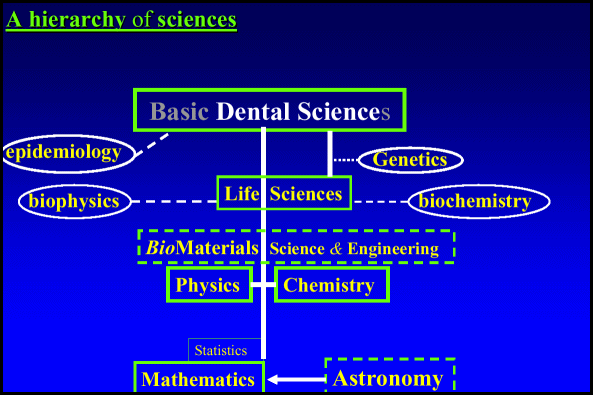
(I love that lecturers put slides on the intranet now. It makes it far easier to mock them.) In fact, he said, all sciences connect to dentistry, “except perhaps oceanography”. So now you know. As such, here’s a slide which clearly impacts directly upon dentistry:
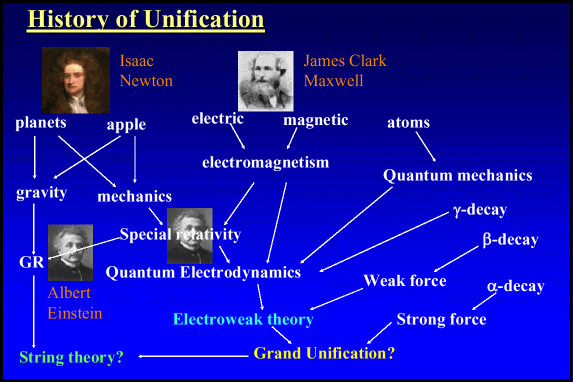
I’m not convinced it makes any sense to unify one thing (such as alpha-decay) with itself, but there you go. I also like that he’s put “planets” and “apples”. Because really, Newton did “unify” the theories behind the motion of planets and that of apples, but the way it’s presented here — and there was not a spoken word of context for this — makes it look like there was a Theory Of Apples.
The lecture was actually delayed because the lecturer had forgotten it was on and turned up forty minutes late.
He stated that there are five SI units (there are seven) and that the second* is defined by astronomy (it isn’t).
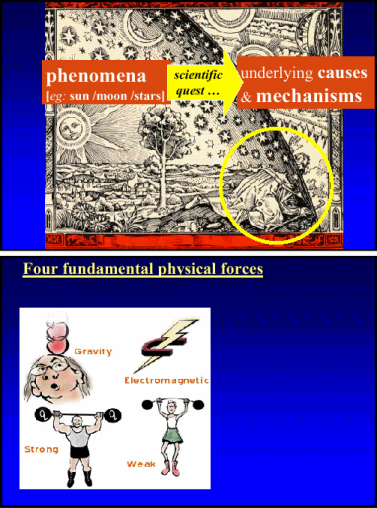
In this slide, he explained that while science was good at finding secondary causes, religion was the path to true understanding:
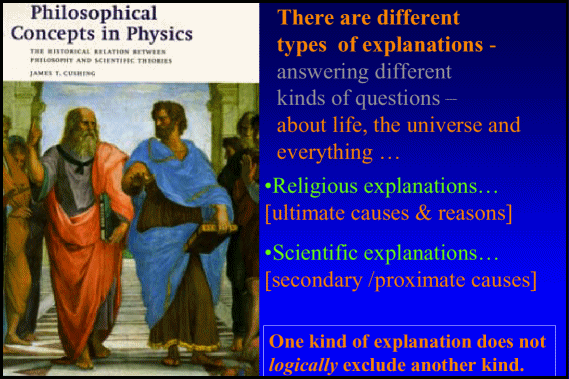
I can’t say I was pleased with this slide (not least because he’s used a famous quote from a vocal atheist to make his point).
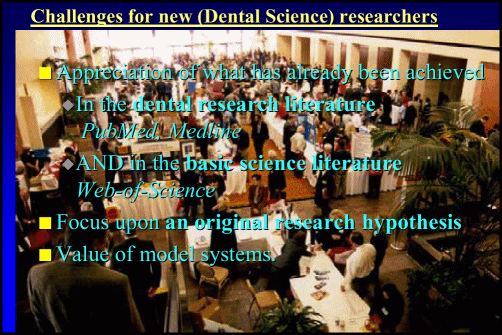
I didn’t like this slide either, but that’s just for composition reasons:
I don’t mean to just sit here and reproduce all his slides. I want to stop somewhere about where I think “fair use” ends. So here’s just a couple more of the most laughable:
I know it looks like I’ve resized the second one badly, but I promise you that’s what the original looked like.
Honestly, this lecture sounded like he’d been told to give a lecture but not what it ought to be about, so he tried to cram the entirety of mankind’s scientific achievement into forty-five minutes in no particular order. He failed. He bounced between sciences (but not oceanography) like a crazy lecture pinball, offering a few facts (and/or lies) about each but no real understanding of any.
I mean honestly, how am I (or anyone else) supposed to learn anything from this drivvel? This took two hours out of my day that I could have spent writing reports which would have saved me time I could have used to write programmes which would have saved me time I could have used to fix all the comupters in the building which would have saved me enough time to actually do some research. But no, it’s a requirement for my PhD that I sit through this nonsense.
Here’s a research question for you:
Why?
Note: this entry has been edited slightly after various comments pointed out an error. In the spirit of honesty I have left the comments in so you can see what error I made. I’m not certain why I’ve done that.
*That is, the unit of time called “the second”, not the second SI unit.
[More Help]
14 Responses to “This Is Why I Complain About Lecturers”
Leave a Reply
Apathy Sketchpad is proudly powered by
WordPress
Entries (RSS)
and Comments (RSS).


November 20th, 2007 at 03:25
I can’t believe you sat there for 40 minutes waiting for a lecturer to turn up.
November 20th, 2007 at 11:33
Well, I was getting paid. And the support act wasn’t quite so late.
November 20th, 2007 at 19:11
Was this meant to be some general lecture on science? Looks totally baffling. To throw the guy one bone, he only unified special relativity and QM - which is OK.
November 20th, 2007 at 19:21
I think so. The Research Methods course is rapidly reaching me that a training in practical dentistry offers a person very little insight into the scientific method, which is a problem for those dentists doing research PhDs. I presume this was a very poor attempt to correct that.
I could follow most of it in the same way that I can watch an episode of Red Dwarf with no sound: I already know it all. I shudder to think what the rest of the class think science is now.
November 21st, 2007 at 14:03
As was said before:
That’s right, he’s only gone and unified quantum mechanics and relativity! It’s only a shame nobody was listening, because I think he’d have got the Nobel Prize in Physics for that.
is wrong. Combining quantum mechanics and special relativity gives you relativistic quantum theory and quantum field theory.
The hard thing is producing a quantum theory of general relativity — that is, quantum gravity.
Mind you, still an abysmal set of slides, and not sure at all what it was supposed to teach anyone……….
November 21st, 2007 at 14:06
Pretty useless stuff in the main, but…
Special relativity and quantum mechanics are “unified” successfully in quantum field theory. The problem is with General relativity and quantum mechanics.
Those chaps in Stockholm’ll have to look for another prize-winner on this one.
November 21st, 2007 at 14:08
Fair enough; I shall trust that you all are right and I was wrong. Are relativistic quantum theory and quantum field theory the same thing as quantum electrodynamics (which is a phrase I think I’ve only ever seen on that slide), then?
I’ve removed that line from the blog, since there’s no real reason to deliberately include a known error, but I’m going to leave the comments as they are because it feels like the right thing to do.
November 21st, 2007 at 14:59
At the risk of appearing a total geek (which sadly I am)…
Quantum electrodynamics is one specific field theory dealing with the interactions of charged particles(fields) with the electromagnetic field(photons). It’s what holds electrons inside atoms…
November 21st, 2007 at 15:07
I see. I am remembering why I elected not to do the theoretical physics modules now. (Although I was forced to do one eventually by Timetable Tetris, and it was actually very interesting, though I think that was just because I had that rare thing, a really good lecturer. Also it didn’t go deep enough to get impenetrable.)
If you don’t want to seem like a geek then you might want to rethink your username. There are at least three words in there that might suggest ‘geek’.
November 21st, 2007 at 15:10
Why?
Because you didn’t go to an insititution that offers a 100% ‘by research’ PhD?
November 21st, 2007 at 15:26
It’s not the institution but the department: 95% of its intake are dentists wanting to do science, so they mostly have to be taught how first. I’m a scientist working with teeth, so from my perspective the course is some useful stats advice padded out with things I already know. And this, of course.
The course itself is useful. This lecture in particular (and its equally irrelevant support act which was mostly pro-Greek propaganda and the lecturer’s particular interests) was not. It was a waste of my time, and I can far more easily see it damaging a person’s understanding of science than aiding it.
Even the bits that were correct were far too unimportant to deserve inclusion and not given enough time to be covered properly.
November 27th, 2007 at 06:33
At last, all of science can be seen as a harmonious whole, thanks to the Grand Unified Dental Theory.
December 2nd, 2007 at 01:45
I don’t see why we should limit it to science. After all, there are different kinds of tooths: there are religious tooths, and scientific tooths…
March 11th, 2008 at 10:45
[...] was thinking in terms of general theories, rather than having one theory for planets and a separate Theory of Apples. Furthermore, introducing the concept of “force” (which we could always simply call [...]